

Africa’s Mineral Turning Point
Africa's Mineral Turning Point: From Geological Wealth to Industrial Power
Africa’s Mineral Turning Point
Africa’s Mineral Turning Point: From Geological Wealth to Industrial Power
A Strategic Assessment paper
Dubai, June 2, 2026
By: Akram MENDAME ZENEDDINE
Advisor and Expert in Strategic Affairs and Socio-economic
- Introduction: A Historical Moment That Deserves a Deeper Read
Nearly every decade, Africa is said to be entering its moment. In the 1970s, the promise was oil. In the 1990s, it was democracy. In the first decade of this millennium, it was the surge in Asian demand and rising commodity prices. Each time, the intermediaries gained more than the continent itself
Today, the promise is once again being put forward, but with a different face. Global demand for strategic minerals tied to the energy transition such as lithium, cobalt, manganese, copper, rare earths, places Africa in an unprecedented position. This time, the cards are genuinely different. However, cards alone do not determine outcome; the ability to play them does.
The fundamental question this paper poses is not “Does Africa possess the resources?”, that answer is well-known and requires no confirmation. The question is: What are the actual conditions that make the shift from extraction to manufacturing possible? and what needs to be built first for that transformation to become viable?
Africa’s Mineral Turning Point
- The Real Issue: Not Resources, but the Structure of the Relationship with Them
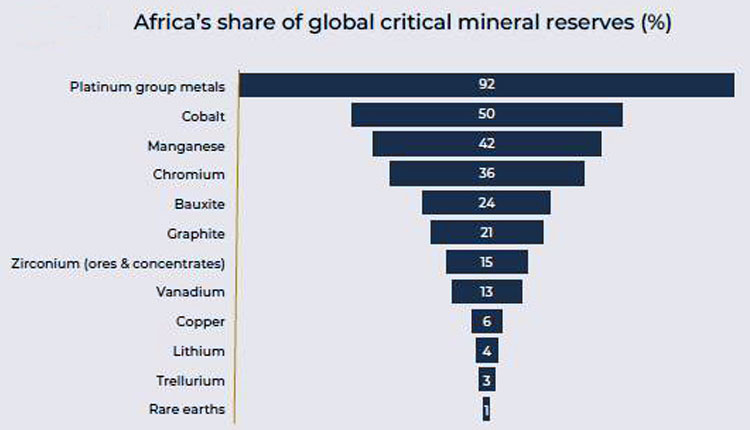
The continent holds about 30% of the world’s mineral reserves. This fact needs no proof. What requires deep understanding is why, for decades, this wealth has been leaving the continent raw and returning as a finished product at doubled prices.
The existing model is not a product of negligence or ignorance. It is the result of an entrenched structure of interests involving multiple parties: international companies holding long-term concession agreements, importing countries that have built their industries on the assumption of continued access to cheap raw materials, and local arrangements in some contexts that have benefited from the perpetuation of this order.
Recognizing this structure is not pessimism; it is the starting point for any serious transformation strategy. Countries that have revisited their contractual framework with international mining partners have found a margin of recovered value that was previously not visible. This margin exists, and the legal and negotiation tools to reclaim it are now more mature than they were a decade ago.
3 . What Has Actually Changed? Three Core Variables
First, a Shift in Demand Dynamics
The green economy is not a slogan but a structural transformation reshaping global demand maps. Achieving internationally agreed climate targets requires enormous increases in the extraction of strategic minerals, and Africa holds the largest share of them. This grants producing nations leverage they did not have to the same extent in previous commodity booms.
Akram Mendame Zeneddine
Countries that build these factors before implementing a transformation decision achieve vastly different results
Second, a Precedent Worth Studying and Adapting
The Indonesian experience of imposing a ban on raw nickel exports teaches us that the success of local transformation decisions is amplified when preceded by three preparatory investments: institutional capacity for execution, securing the right industrial partnerships and ensuring energy as a prerequisite rather than an afterthought. Countries that build these factors before implementing a transformation decision achieve vastly different results than those who launch the decision and then wait.
Third, Multiple International Players as a Margin for Maneuver
The competition among major powers for strategic minerals, the Gulf’s growing interest in economic diversification, and Europe’s search for secure supply chains all provide African nations with a wider margin for maneuver than was available in previous decades. However, this margin for maneuver does not automatically translate into a strategy without an organized entity capable of leveraging it.
- The Minerals Transformation Model: From idea to Ecosystem
The core idea behind the most prominent metal transformation initiatives on the continent, including the A2MP platform as a model worth following, is that minerals should be smelted, refined, and transformed into added value within the continent before it leaves.
What distinguishes this model is not the volume of its achievements so far, but the logic of integration it proposes across five interconnected pillars: extraction, manufacturing, energy, logistical infrastructure, and value capture within African economies. This is a logic upon which policies should be built, rather than waiting for its proven success.
An industrial smelter within this model is not merely a factory; it is an engine for an entire economic ecosystem. It provides what every energy investor seeks: a guaranteed customer and stable demand for decades. This, in turn, creates the economic viability for building power generation plants in areas previously far from the grid.
Around the smelter, industrial zones, logistical infrastructure, and worker communities emerge, requiring services, trade, and education. Here, the project is no longer just a mining venture; it transforms into an integrated development platform with ripple effects across multiple sectors.
This is what has occurred in several successful industrial experiments in Asia, and it is what some Gulf countries are attempting to achieve through industrial cities built on massive energy resources.
- The Social and Digital Environment: A Dimension That Cannot Be Ignored
Mega-projects in the minerals transformation sector are tested not only for economic or technical feasibility but also today in a more complex environment: the surrounding digital and social landscape. Those working in this sector know that a strong presence on digital platforms has become a genuine leverage point for those seeking to benefit or obstruct progress. Ignoring this reality is not boldness; it is a planning loophole.
Companies and governments that recognize this early do not wait for pressure to act; they build their defenses before launching their projects. These defenses do not come from public relations or defensive responses, but from something deeper and more enduring: genuine integration with the social fabric surrounding the project.
Counselor Akram Mendame Zeneddine
Partnership is the most effective shield against any pressure campaign
When benefits reach grassroots communities tangibly, verifiably, and as planned from the outset, through local employment, subcontracting, services, and infrastructure, society transforms from a spectator into an active partner. This partnership is the most effective shield against any pressure campaign, regardless of its digital scale.
Preliminary social studies and detailed plans for benefit distribution are not a luxury to be added at the end of planning; they are part of the project’s very engineering. Projects that understand this gain two things simultaneously: operational legitimacy locally, making them more stable, and international financial attractiveness, making them more sustainable.
- Structural Conditions for Transformation: What Cannot Be Overlooked
Based on comparative experiences, four conditions for any successful mineral industrial transformation can be identified, operating concurrently, not sequentially:
Negotiating Sovereignty Precedes Legislative Sovereignty.
Changing the law is easier than altering the balance of power at the negotiating table. Technical, legal, and institutional capacities that make the African party a true partner, not just a signatory, determine the quality of the contract signed.
Energy as a Backbone, Not an Appendage.
Any metal transformation strategy must begin with the energy equation, not add it later. A smelter that cannot find reliable energy at a competitive price becomes a liability rather than an asset.
Regional Integration as Negotiating Leverage.
African mineral wealth is geographically dispersed but industrially complementary. A party negotiating in isolation obtains far less favorable terms than a bloc negotiating collectively. The regional legal framework exists; the actual negotiation content awaits construction.
Managing Strategic Time.
The available window is real but limited. Parallel investment in technologies that reduce reliance on primary metals is progressing rapidly in major industrialized nations. Every year of delay in building the local transformation ecosystem is a year in which the negotiating leverage erodes.
- The Mine of the Future is Measured Not by Production, but by What Remains on the Continent
In past decades, the success of a mining project was measured by the number of tons extracted and the value of exports. Today, global competition has shifted from owning the minerals to controlling what comes after. It is precisely here that the dimension, often overlooked by many strategies because it is invisible and not directly measurable in tons or dollars lies.
The First Dimension is Industrial Data. Whoever owns the data for extraction, refining, and supply chains has the ability to forecast prices, time supplies, and negotiate from a position of knowledge, not need. In the new metals economy, data is not merely a management tool; it is a strategic asset in itself.
The Second Dimension is Technological Ownership. The difference between a country exporting raw material and one manufacturing value lies not in the mine, but in the patents for refining, processing, and the technologies that transform metal into product. This ownership is the dividing line between those who sell material and those who sell the knowledge embodied in it.
The Third Dimension is Position in the Global Value Chain. Production is not the only important factor, where you stand in the chain from mine to battery or chip makes a big difference. Every step upward in this chain signifies higher value, less dependence, and greater negotiating power. Countries that secure their position in higher stages become part of the global equation, not just a replaceable resource.
Akram Mendame Zeneddine Advisor and Expert in Strategic Affairs and Socio-economic
In a world rapidly reshaping its supply chains, nations capable of integrating mining with data, technology, and manufacturing will be better positioned to negotiate, attract investment, and achieve sustainable growth. Economies content with exporting raw materials may find themselves years later facing a market less dependent on their resources and more reliant on knowledge and advanced manufacturing.
Therefore, the question that will determine Africa’s position in the coming decades will not be: “How many tons did we extract?” but rather: “How much value did we add?” and “How much knowledge did we retain within the continent?”
- Conclusion: The Cost of Delay Is Not Neutral
The available time window is real but limited by the nature of ongoing technological transformations. Nations and institutions that build the local metal transformation ecosystem today, under its four conditions, accumulate strategic capital that will be difficult to surpass later. Delay, however, is not a neutral stance; it is, in itself, a decision to remain within the old model.
Africa does not need to be convinced that it possesses wealth. It needs strategies that transform geological wealth into negotiating power, negotiating power into industrial structures, and industrial structures into genuine technological and social accumulation.
This path is long, costly, and winding, but it remains the only way to transform Africa from a source of raw materials into a creator of value and an active participant in shaping the coming global economy.
Akram MENDAME ZENEDDINE,
Advisor and Expert in Strategic Affairs and Socio-economic
التعليقات مغلقة.